

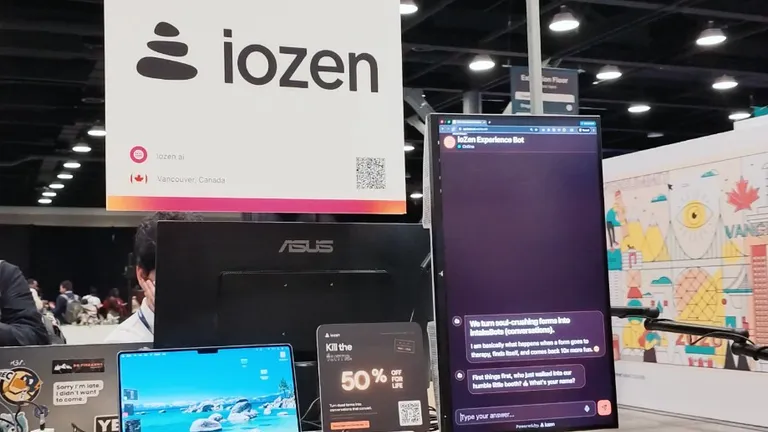
The most memorable conversation I had at Web Summit in Vancouver this spring started with someone who wanted to argue.
She walked up to our stand already skeptical. The phrase that caught her attention was “forms are dead,” and she was having none of it.
“Forms are inevitable,” she said. Not as a question.
I asked her one thing: “Do you like filling out forms?”
She didn’t pause. “Of course not. Nobody does.”
“That’s exactly the point.”
She wasn’t convinced. So I handed her the microphone we’d set up at our stand, told her to try it, and said she could tell me what she thought after.
What was actually going on in her brain
There is research behind why she hated forms before she’d ever used ioZen.
When you face a form, something specific happens in the brain. You shift into evaluation mode, a mild version of the stress that comes from being assessed before you’ve had a chance to explain yourself. It’s the same mental posture as sitting across from someone who’s already judging your answers. Most people wouldn’t name it, but it’s there, and it pushes people toward the exit.
Layer on top of that the attention problem. Nir Eyal described the dopamine cycle in Hooked in detail: social media has trained our brains to expect fast rewards. Short hits of gratification, constantly. The cost of that is an attention span that collapses the moment something asks for sustained effort. A long form isn’t just friction. For most people today it’s genuinely difficult to sit through.
So people don’t. They rush. They answer carelessly. They pick options almost at random if nothing depends on it. And often they abandon entirely, which is why 81% of people who start a form never finish.
The quality of what your business collects from a form depends partly on what state the person was in when they filled it out. That’s a problem with the format, not the person.
What we built to solve it
The new Content Blocks feature in ioZen lets you drop engagement moments between questions. Not more questions. Moments.
A content block can validate what someone just shared: “That makes sense, a lot of people in your situation start here.” It can give a small push: “You’re about halfway through, the next part is quick.” It can make a relevant observation about what the person has already told you. It can even make a joke if the tone fits.
The AI does this contextually. It actually reads the previous answers before writing the block, so it doesn’t feel scripted. It feels like a person who was listening.
That shift matters more than it sounds. When the intake responds to what you said instead of just asking the next question, you stop feeling interrogated. You start feeling like you’re in a conversation. Those are different experiences in the brain, and they produce different behavior.
The tones
We also shipped configurable tones for the entire intake. When you create an Intake Bot, you can now set a voice that runs through every question and every content block.
Formal, professional, casual, fun. Or what we’re calling ludicrous, which is exactly what it sounds like.
Some businesses need something more relaxed to get people to actually engage. Some want to stand out from the pattern of boring, corporate intake. Ludicrous mode exists for the cases where the goal is to be genuinely memorable. It’s not for everyone. But for the right context it opens up possibilities that no traditional form ever could.
The nine magic moments
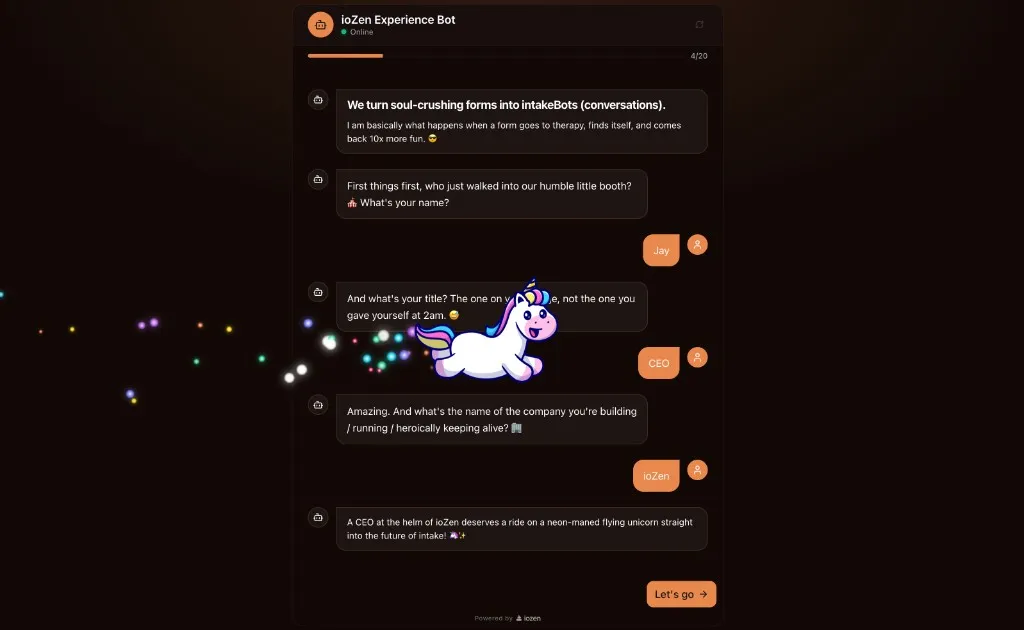
Inside the content blocks, we built nine “magic moments”: fireworks, confetti, a gong, a flying unicorn, a storm, a color portal, curtains that open and close, and a couple others. These are animated, visual, full-screen moments that fire at the right point in the conversation.
They break the pattern. They give the brain a small, unexpected reward. They signal that this isn’t the same thing you’ve filled out a hundred times before.
Back to the woman at the stand.
She spoke into the microphone. The Intake Bot filled her answers in automatically, reading her voice. That surprised her. But it wasn’t until she submitted the first section and a content block appeared, with a message that made a genuinely funny joke about something she’d said, followed by a unicorn flying across the screen trailing color bubbles, that her face changed.
She laughed. Not a polite smile. She laughed and then kept going. Next, next, next. Fully engaged.
When she finished, I asked her: “Have you ever smiled filling out a form before?”
“No, never.”
“I saw you laugh.”
She paused. Then she said: “You sold me. How does this work and what does it cost? I run an NGO and we have awful forms everywhere. Do you have nonprofit pricing?”
She’d walked up to our table to argue. She left asking about pricing.

Why this works
The magic moments aren’t decoration. They’re small, deliberate dopamine hits, the same mechanism that makes social media sticky, redirected toward something the person is actively completing. Each one fires after progress. Each one makes the next step feel easier.
Combined with content blocks that make people feel heard and a conversational structure that never shows the whole form at once, the intake stops feeling like a test and starts feeling like a useful exchange.
You’re not tricking anyone. You’re designing an experience that works with how human attention actually functions in 2026, rather than pretending people can focus on eleven fields at once.
A form asks people to adapt to the system. An Intake Bot with content blocks and magic moments adapts to the person.
That’s the difference. And it’s big enough to turn a confirmed skeptic into a customer in about three minutes.
If you want to see what this looks like in practice, you can try a live demo without signing up. If you want the psychology behind why forms lose people in the first place, start with why your brain hates forms.
Tags:

Written by
Jay Moreno
Founder & CEO, ioZen
Technical founder with 20+ years building platforms across Latin America. Founded PATIOTuerca (first Ecuadorian startup to IPO), Vive1, Evaluar.com, and Taxo. Now building ioZen to liberate humanity from bureaucracy.